
Home
Center Research
About Our Research
Center Research
Clinical Research
[Stage 4 Pilot Project] Prospective Observational Study on Patients with Knee Pain
1. Introduction
- This prospective observational study was conducted as part of the Korean Medicine and Western Medicine Collaboration Pilot Project.
- The collected data will be used to analyze the clinical and cost-effectiveness of collaborative treatment.
- Participants will receive usual care and participate in the study by completing surveys three times over an 8-week period.
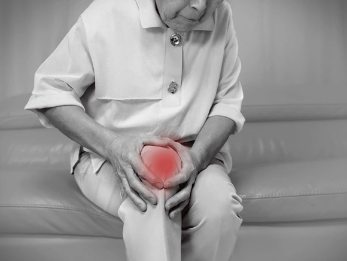
- Knee pain is a common symptom observed in primary care settings. One-quarter of the population aged 55 and older experience knee pain, and more than 40% of those aged 65 and older show symptoms of arthritis in the knee or hip joints.
- Knee pain (degenerative knee osteoarthritis), a frequent condition in middle-aged and elderly individuals, is expected to increase further in an aging society. For individuals, it serves as a major cause of severe pain and activity limitations, significantly impacting daily life and quality of life. From a societal perspective, it is a key condition contributing to productivity loss.
2. Participants
- Adults aged 19 years or older.
- New outpatients at institutions participating in the Korean Medicine and Western Medicine Collaboration Pilot Project.
- Patients with a primary diagnosis related to knee pain, based on the KCD codes listed below.
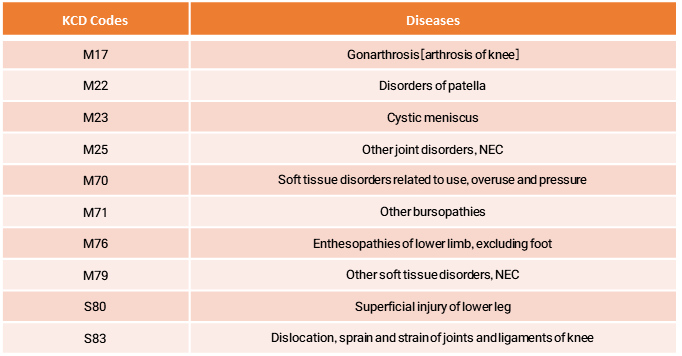
※ Exclusions : Patients covered by automobile insurance or those participating in other research (except observational or survey studies).
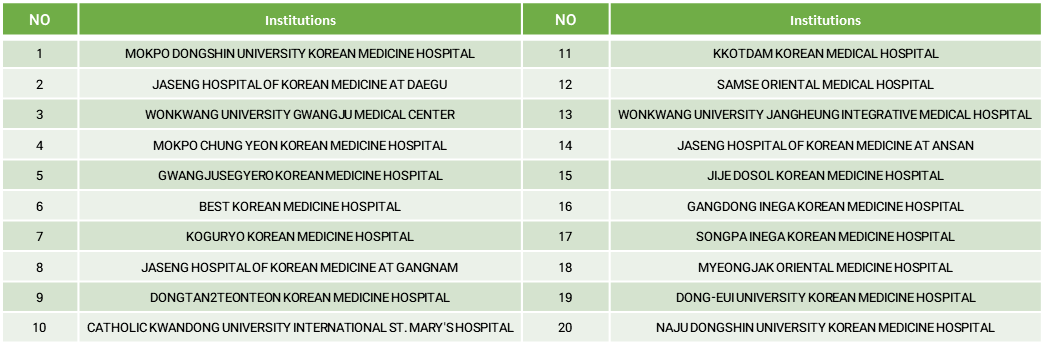
- List of participating medical institutions
3. Study Settings
1) Registration of Study Participants
- After the initial consultation, patients who voluntarily express their willingness to participate and meet the eligibility criteria will be registered as study participants after receiving an explanation from the attending doctor.
2) Medical Consultation
- Physicians or Korean medicine practitioners at the institution will assess the necessity for collaborative treatment and provide care. At this stage, participants will be categorized into either the collaborative treatment group or the non-collaborative treatment group.
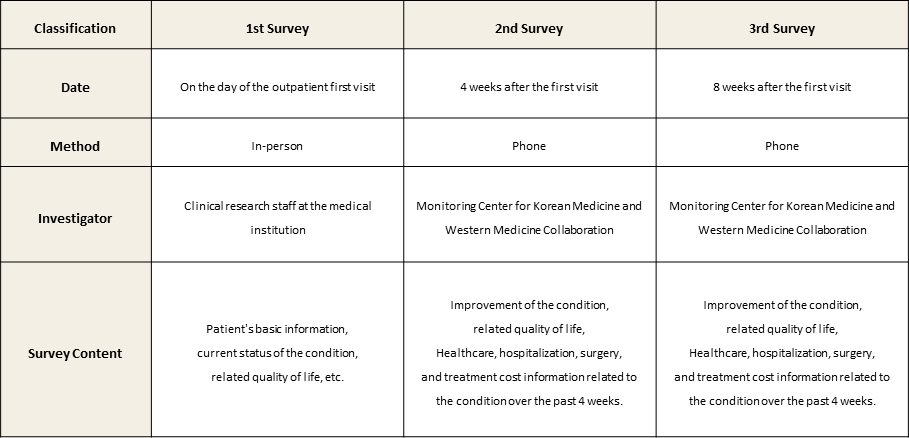
3) Surveys and Data Collection
- The first survey will be conducted by the staff at the medical institution, collecting the patient’s basic information, the severity of their condition, and their quality of life.
- The second survey (4 weeks after the initial visit) and the third survey (8 weeks after the initial visit) will be conducted by the Korean Medicine and Western Medicine Collaboration Monitoring Center via phone. These surveys will gather data on the progress of the condition, changes in quality of life, and medical costs (e.g., visits, hospitalizations, surgeries, and treatments) incurred over the past four weeks.
- Importantly, staff at the Monitoring Center will not know whether participants belong to the collaborative treatment group or the non-collaborative treatment group.
4) Result Analysis
- Data collected from study participants, along with electronic data from the Health Insurance Review and Assessment Service (HIRA), will be analyzed to evaluate the clinical and cost-effectiveness of collaborative treatment.
4. Research Ethics and Safety
- The study has received approval from the Institutional Review Board (IRB).
- As this is an observational study, no risks are anticipated for participants.
- Information and data collected from participants will be securely protected to ensure that their identities cannot be directly identified.
- Original data collected during the study will be stored for three years and then destroyed.
- Participants have the right to withdraw their consent at any time.
- To ensure fairness in the study, the Korean Medicine and Western Medicine Collaboration Monitoring Center will not be aware of whether a participant belongs to the collaborative treatment group or the non-collaborative group during the second and third rounds of data collection.









하단영역

- Address
- Research Institute for Korean Medicine, Pusan National University, 20, Geumo-ro Mulgeum-eup, Yangsan-si Gyeongsangnam-do, 50612, Pusan, Republic of Korea
- Director of the Center
- Namkwen Kim
- Contact Us
- +82 55-360-5992
- Email Inquiries
- mcmc.monior@gmail.com
Copyright (C) Monitoring Center for Korean Medicine and Western Medicine Collaboration. All rights reserved.Designed by WebSite.co.kr